GCDD Fall 2026 DD Primer
Download the PDF version of this primer
The mission of the Georgia Council on Developmental Disabilities is to bring about social and policy changes for the wide spectrum of diverse Georgians with developmental disabilities and their families to live, learn, lead, work, play, and worship in their communities.
Table of Contents
- What is a Developmental Disability
- The Power of a Waiver
- Dollars and Sense: Return on Investment
- FY 23 I/DD Fiscal Effort for the Southeast Region
- Medicaid Matters for Georgians with DD
- Public Policy Recommendations to Impact Georgians with DD
- Sources
What is a Developmental Disability?
Every person is different- but everyone with a developmental disability (DD) needs support in three or more life areas. These are disabilities that:
- Start before the age of 22
- Last the person’s entire lifetime
- Might make it hard for them do some things on their own. They may need support or help.
A person with a DD may need help:
- Doing everyday things like eating, dressing or bathing
- Understanding what people say and speaking so that people understand them
- Learning and remembering things
- Making choices/decisions and directing their life
- Living on their own
- Being mobile/getting around on their own
- Having a job and managing their money
An estimated 246,374 Georgians have developmental disabilities. In GCDD’s 2025 survey,
the #1 need identified was more services and supports in their communities, including NOW/COMP waivers.
Many believe Georgians with the most significant disabilities have the support they need to live at home, pursue careers, and participate in their communities. Unfortunately, that’s not the reality. As of this fall, after attrition, 1,215 Georgians are on the urgent list for a NOW/COMP waiver, with thousands more waiting.
Based on research, data, and input from hundreds of Georgians, this primer highlights some of the most critical issues facing Georgia’s developmental disability community.
The Power of a Waiver
The impact of a developmental disability is different on every person. Some people with the most significant impact require support from Medicaid to be able to live in communities, instead of living in hospitals or institutions. The evidence shows that no matter what developmental disability a person has, or how much it impacts them, they can live in the community with proper support.
Matt Gaffney is one example. As a young adult, he spent over a year at Gracewood, a state hospital for people with disabilities. Later, Matt was institutionalized again at Central State Hospital. Matt and his parents fought for him to leave. Eventually Matt found a provider agency that can support him at home.
Matt has now lived in Athens for 25 years and has never had to go back into a hospital. He works at the YMCA, and enjoys going to concerts.
Nick Papadopoulos spent his 40s in a skilled nursing facility, before finally moving home in 2026. In the nursing home, Nick could not wear his own clothing, could not drink a beer without a prescription, and could not leave the facility without permission.
Now, Nick reflects, "I can contribute to my local economy. I can shop at neighborhood businesses, eat in local restaurants, bank, volunteer, vote, and someday return to work. I want to pay taxes. I want to be known as a neighbor instead of a resident of an institution."
Matt and Nick are able to live fulfilling lives in their Georgia communities because they have COMP Medicaid waivers. NOW and COMP are Georgia's Medicaid waivers for people with developmental disabilities. Waivers provide services so that people can live in their own homes and communities instead of living in facilities. Only people with the most significant impact of their disabilities qualify for NOW/COMP.
Some states provide their citizens with developmental disabilities with waivers at the time they need them. For most people, this is around age 22, when they leave high school. Oklahoma is one example that has committed to being a "no wait state".
Most Georgians with developmental disabilities do NOT even qualify for a waiver. But even Georgians who qualify often wait for years.
Our state funding for waivers has not kept up with citizen need. This table shows the number of Georgians who are qualified and waiting for waivers, compared to the number of new waivers funded in the state budget that year.
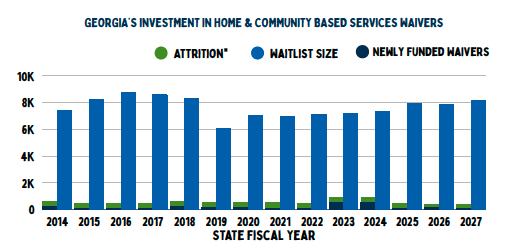
Not everyone on the waiting list needs a waiver right away. But according to state data, some people on the list are in urgent need.
According to July 2026 data from the Georgia Department of Behavioral Health and Developmental Disabilities (DBHDD), a total of 8,130 people are on the waiting list. Out of those people:
- 1215 Georgians waiting are in urgent need of a waiver
- 4905 Georgians waiting are age 23 or older
Once someone turns 23, they no longer get services in their public schools. Often these Georgians and their families feel like they are hanging on by a thread.
Paul is the caretaker for his granddaughter, who finished high school without a waiver. Paul needs his job to support them, but can’t leave his granddaughter alone all day. He quietly brings her into work, and lives in fear of his boss finding out and firing him. That’s why we don’t give his last name.
Earlise Acey’s daughter Trenity is 24. In high school, she enjoyed friendships and cheerleading. Now she’s isolated at home and on the waiting list. Earlise struggles to find work that will support them and allow Trenity to pursue her dreams of continuing her education and working
with animals or children. Earlise is Trenity’s only family.
These needs of Earlise, Trenity, Paul, and the thousands of other Georgians waiting for a waiver can be met, if the state chooses to invest in these families.
"This is not theoretical to me. This is not a line item. This is my child's life trajectory." - Kelly Fields, Gainesville parent
Dollars and Sense: Return on Investment
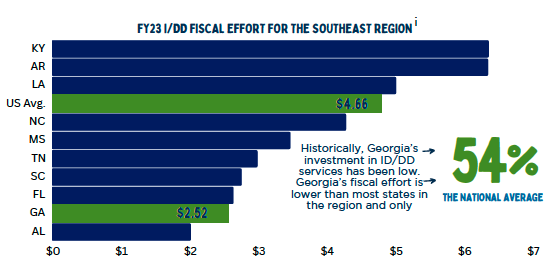
Georgia is an outlier regionally and nationally for our low level of investment in adult developmental disability services. The chart below shows Georgia’s fiscal effort, compared to the US average and other neighboring states. Georgia is second to last in the southeast. Compared to other states, the amount of fiscal effort we invest in these families is among the lowest in the country.
FY23 I/DD Fiscal Effort for the Southeast Region(i)
Historically, Georgia’s investment in ID/DD services has been low. Georgia’s fiscal effort is lower than most states in the region and only 54% of the national average. In fiscal year 2023, the U.S. average was $4.66. Georgia was $2.52.
The fiscal value of a waiver includes the return on investment for the state of Georgia, as well as the individual and family who are served. Research shows waivers benefit the state by keeping people in the workforce, improving health outcomes, and avoiding the more expensive costs of institutional and hospital care.
- Workforce – parents whose children with DD receive waivers are more likely to remain in the workforce than parents whose children do not have waivers (ii)
- Health – people with DD who have waivers have better health outcomes than people with IDD who don’t have waivers. People who have waivers also have better health outcomes than people who live in hospitals or institutions. (iii, iv)
- Avoid expensive institutional care – the average cost of an intermediate care facility for people with intellectual and developmental disabilities (ICF/IDD) is more than triple the cost of an average COMP waiver.
| NOW waiver | COMP waiver | UCF/IDD facility | |
| Average annual cost | $16,200 (v) | $104,000 (vi) | $358,900 (vii) |
Medicaid Matters for Georgians with DD
Medicaid, often called “the lifeline”, allows Georgians with DD to get healthcare AND get services and supports to live in their communities instead of institutions.
When cuts or changes are considered, the needs of people with DD must be carefully considered to maximize benefits and avoid unintentional harm.
- What would expanding Medicaid do?
- Expansion WILL make more Georgians eligible for Medicaid health coverage, including some Georgians with disabilities and some of their family members
- Expansion WILL NOT address the NOW/COMP waiver waitlist
- What do Georgians with DD use Medicaid for now?
Katie Beckett (Deeming) Waiver
- Provides Medicaid eligibility for children with disabilities under 18
- Eligibility is based on the child’s needs, not parental income
- Allows children with complex needs to grow up at home
Foundational Medical & Behavioral Care
- Primary and preventive care, including routine doctor visits and health screenings
- Hospital, emergency, and outpatient services
- Medically necessary prescription medications
- Mental and behavioral health services
- Physical, occupational, and speech therapy
Home & Community-based services (HCBS) - NOW AND COMP WAIVER
- For Georgians with significant disabilities
- Allows Georgians to live at home instead of institutions
- Allows Georgians to work, play, and worship in their communities
Early and Periodic Screening, Diagnostic, and Treatment (EPSDT) (Children & Youth Under 21)
- Preventive health and developmental screenings
- Early identification of physical, behavioral, and developmental conditions
- Intervention to keep children with disabilities healthy and at home
Public Policy Recommendations to Impact Georgians with DD
- Fund urgently needed waivers – According to DBHDD data, after attrition, 1215 Georgians are in urgent need of a waiver as of July 2026. The state can fully fund this in SFY 28.
i. $15.7 million will fund ~ 1215 urgently needed waivers
ii. $2.5 million will fund 26 DBHDD staff to administer waivers - Provide & protect Medicaid for Georgians with DD – The state can provide and protect Medicaid services, including medical & behavioral & dental health care, NOW/COMP waivers, Katie Beckett waiver, and Early and Periodic Screening, Diagnostic & Treatment for Children.
- Support the Workforce – The state can conduct a provider rate study to begin in 2027, in accordance with the 2022 Georgia Senate Bill 610.
- Establish an Intellectual & Developmental Disabilities Commission – The state can implement a Commission modeled on the Behavioral Health Reform and Innovation Commission, using statewide partnerships and data to drive collaborative, well-informed system change.
- Adopt “Waiver When Ready” – Once urgent needs are addressed, the state can fund a multiyear plan so all Georgians who qualify for NOW/COMP receive a waiver when they need one to live, work and thrive in their communities. Most people are ready for a waiver once they finish high school.
- Support family caregiving and self-direction – The state can ensure that using family caregivers and self-directed (participant-directed) waiver services remain options for NOW/COMP waiver recipients, in addition to the option of getting services from a provider agency. The state can implement adequate quality oversight that does not overburden families in red tape.
Sources
- Tanis, E.S., et al.(2025). The State of the States in Intellectual and Developmental Disabilities, Kansas University Center on Developmental Disabilities, The University of Kansas. http://StateoftheStates.org
- Leslie et al. 2017 https://www.healthaffairs.org/doi/10.1377/hlthaff.2016.1136
- Hargan 2017 https://www.medicaid.gov/sites/default/files/2019-12/mfprtc.pdf
- McLean, Hoekstra, and Bishop 2021 https://onlinelibrary.wiley.com/doi/full/10.1111/jar.12837
- GDAA 2025 https://www.audits2.ga.gov/reports/summaries/now-and-compwaivers/
- GDAA 2025 https://www.audits2.ga.gov/reports/summaries/now-and-compwaivers/
- IHDD 2025 https://ihdd.org/2025/10/15/state-of-the-states-in-i-dd-releases-2025-update/
- Estimate assumes 70% of people on urgent list need COMP at average $104,000 and 30% need NOW at average $16,200. At FMAP of 66.63%, a state dollar investment in SFY 28 of $15,736,125 will get a federal match of $31,420,375 to fund the first year.
For More Information
For more information or for any questions, please do not hesitate to contact:
Kaylon Day, GCDD Public Policy Director at or 470.787.9106
GCDD Offices at or 404.657.2126