October 2026

October 2026

Feature Article

Know Before You Vote! What Georgia Voters Need to Know for 2026 Midterm Elections

Georgia’s general election is November 3, 2026. Voters can cast their ballot in three ways: voting early in-person, by absentee ballot, or at their polling place on Election Day.

“With each of these options, there’s planning that has to happen,” said Stacey Ramirez of REV UP Georgia. “Make sure you understand the process and the steps so that your voice is heard and your ballot is counted.”

What Happened with the Absentee Ballot Order?

In March, President Donald Trump signed an executive order that would have changed how mail-in ballots are handled in federal elections. States would have needed to give the U.S. Postal Service lists of voters approved to receive mail-in ballots. These are also called absentee ballots. The Postal Service also created new rules for ballot envelopes, barcodes, and voter information. Ballots that did not meet those requirements could have been refused.

Twenty-three states and voting rights groups challenged the order in court. They said the federal government did not have the authority to make these changes. They also said that changing the process so close to the election could create confusion and keep some ballots from being delivered.

On September 14, the Supreme Court decided not to let the new requirements take effect for this election. Mail-in voting will use the usual process for 2026. However, the issue may come up again in future elections.

For Georgia voters, the important thing to know is that absentee voting is still available for the November election.

How to Vote by Absentee Ballot

“The process for absentee ballot voting is well established,” said Dan Crimmins of REV UP Georgia. Any registered Georgia voter can request an absentee ballot. They do not need to give a reason. But, Georgia does not automatically send every voter an absentee ballot. So they need to apply first.

People can apply online through Georgia’s absentee ballot portal. They can also send an application to their county elections office by mail, email, or fax, or they can deliver it in-person. The county elections office must receive the application by October 23, 2026.

When your ballot arrives, read all the instructions before filling it out. If you need help, federal law allows voters with disabilities to choose someone to assist them, with a few exceptions. Learn about your right to voting assistance.

The county elections office must receive the completed ballot by 7 p.m. on Election Day. A postmark showing that it was mailed by Election Day is not enough. Dan Crimmins of REV UP Georgia recommends mailing your ballot as soon as possible, “preferably weeks in advance,” he said.

If Election Day is getting close, consider using an official drop box or taking the ballot to your county elections office. Check My Voter Page to see whether your ballot was received and accepted.

Making Your Voting Plan

Start with Georgia’s My Voter Page. It is the main resource for election information. You can use it to:

  • Check your registration status
  • Find your Election Day polling place
  • Find early-voting dates, hours, and locations
  • View a sample ballot
  • Track your absentee ballot

Your registration may be marked “inactive” if you have not voted or contacted election officials for five years. You can still vote with an inactive status.

“If it is inactive, all you have to do is go vote,” Ramirez said. “Don’t not go vote because it’s inactive.”

Then, plan when and where you will vote. Early voting begins October 13, 2026. A good thing about early voting is that people can vote at any voting site within their county. This is different from Election Day, when they must vote at your specific precinct.

Check your photo ID. The Secretary of State website has a list of acceptable ID’s for in-person voting.

Next, how will you get to the polling place? Do not wait until Election Day to arrange a ride. “It’s okay to ask for a ride,” assured Crimmins. “People are willing to help.” Depending on where you live, you may also be able to schedule a free ride with Ride 2 the Polls.

Know Who Is on Your Ballot

Don’t make the polling booth be the first time you’re looking at your ballot. Find your sample ballot on My Voter Page and research the candidates and issues ahead of time.

Ballotpedia.org has unbiased information on the candidates up for election. REV UP Georgia also created a plain language voter guide. This document also has unbiased information about candidates and their positions on disability issues. Neither of these sources support or oppose any candidate or political party.

Once you make your choices, print or complete a paper copy of your sample ballot to take with you. Georgia limits cell phone use at polling places.

Resources for Voters with Disabilities and Their Families

REV UP Georgia offers nonpartisan resources for voters with disabilities. Its Are You Vote Ready? campaign walks voters through each part of the process.

With funding from the Georgia Council on Developmental Disabilities, REV UP Georgia also created an 11-part voter education video series.

If you have a question or face a problem while voting, call or text the nonpartisan Election Protection hotline at 866-OUR-VOTE (866-687-8683). It’s important to report problems even if they are resolved. These reports can help identify patterns and barriers that affect voters across the state.

No matter how you choose to vote, start planning now. Know the steps, check your information, and ask for help when you need it.

Public Policy For The People, Feature Story

Feature Article 2

Celebrating Value and Talent with Advancing Employment

This October marks the 81st anniversary of National Disability Employment Awareness Month (NDEAM), an annual celebration of the positive impact of people with disabilities in the American workforce. The theme for NDEAM 2026 is “Celebrating Value and Talent.” In Georgia, Advancing Employment is leading NDEAM celebration events.

Advancing Employment is Georgia’s training and technical assistance center for best practices in employment supports. It works to create and improve employment supports and systems in Georgia so workers with disabilities can find and keep jobs in inclusive workplaces. Advancing Employment supports job seekers with disabilities, employment service providers, and businesses. This helps to make inclusive employment a reality across Georgia. The program is part of the University of Georgia’s (UGA) Center on Human Development and Disability. It is one of UGA’s oldest continuously funded federal programs.

Advancing Employment began as a small project more than 10 years ago. It was originally created as a technical assistance center and has grown into a statewide resource for inclusive employment. Support from the Georgia Council on Developmental Disabilities (GCDD) has helped the program to grow.
Doug Crandell is the project director at Advancing Employment. He explained why the funding matters. “The truth is, if GCDD didn't fund it, we wouldn't have a center in Georgia.”

Helping People Find and Keep Jobs

Advancing Employment has become a central location that helps lead NDEAM activities across Georgia. It encourages businesses of all sizes to take part and learn. The program shares resources and information to help people get jobs. It also helps people understand policies that affect workers with disabilities.

This work supports competitive integrated employment (CIE). CIE means jobs where people with and without disabilities work together, earn fair wages, and have equal chances to grow in their jobs. According to Crandell, every person who gets a job in Georgia gives back more than $3,000 a year to taxpayers.

Training and Support

Advancing Employment offers in-person and online training through its Education Opportunities program. Training is available to job coaches and other staff who help people to keep their jobs. Families and organization leaders can also take part. This includes staff from two state agencies: the Georgia Department of Behavioral Health and Developmental Disabilities (DBHDD) and the Georgia Vocational Rehabilitation Agency.

Trainings for professionals, job seekers, and families teach ways to support workers. Participants take tests before and after each training measure what they have learned.

Advancing Employment also shares resources with employers. These explain the benefits of inclusive hiring and how it can help a business. Resources include economic presentations, employer toolkits, and more.

Learning Together

Advancing Employment hosts an online Community of Practice (CoP) meeting each month. People who provide employment services can share ideas and resources. They discuss how to support people with disabilities in reaching their job goals. These meetings also help the program learn what support providers need. They also help communities start local hiring councils.

Advancing Employment is bringing people, providers, and businesses together to create more job opportunities across Georgia.

Join the NDEAM Celebration

On October 27, 2026, Advancing Employment will host its annual NDEAM awards celebration at the Tubman Museum. The event will recognize the value and talent that workers with disabilities contribute to Georgia. It will also help set Advancing Employment’s 2027 Policy Imperative goals.

The celebration will include an awards ceremony and presentations from the GA Neurodiversity Chamber of Commerce, DBHDD, and the Ralston Institute/Center on Human Development and Disability.

When: Tuesday, October 27, 2026, from 9:00 a.m. to 1:00 p.m.
Where: Tubman African American Museum, 310 Cherry Street, Macon, GA
Register for the event

Follow GCDD to celebrate and learn how to build more opportunities for workers with disabilities!

Feature Story

Letter from Leadership

Letter from Leadership: Building Georgia’s Next Five Years Together

IMG 003 MarkCrenshawThe Georgia Council on Developmental Disabilities is beginning a new five-year plan. This plan will guide our work for the next five years.
I serve as chair of GCDD’s State Plan Committee and as a member of the Executive Committee. I am also an assistant director and the training director at the Center for Leadership in Disability at Georgia State University.

I have served with GCDD for about eight years. During that time, I have seen how GCDD’s work can help people with intellectual and developmental disabilities and their families.

GCDD created the new plan with input from people with disabilities, family members and other community members. We listened to what people said they needed. Then we used their feedback to choose the plan’s goals.

When people read the plan, I hope they see their needs and priorities in it. This plan should be about what matters to Georgia’s disability community.

One important part of GCDD’s last five-year plan was growing self-advocacy across Georgia.

Through Uniting for Change and other efforts, people with disabilities have learned new advocacy and leadership skills. They have connected with other self-advocates and shared their stories.

This work will continue under the new plan.

GCDD wants to give more people with disabilities the skills and opportunities to speak up about the issues that affect them. We also want more people to share their experiences with state and federal leaders.

Policies are stronger when they include the voices of people with disabilities and their families.

The new plan will also focus on loneliness and social isolation.

Many people with disabilities do not have enough opportunities to meet others, build relationships or take part in their communities. GCDD wants to support new community-based ideas that help people make meaningful connections.

People with disabilities should have opportunities to belong, form friendships and be active in their communities.

GCDD will also work to make information more accessible.

Government plans are often written in technical language because they must meet federal requirements. That language can make plans difficult to understand.

We have a responsibility to explain GCDD’s work in clear and accessible ways. People should understand what the new plan says, why it matters and how they can participate.

The new plan includes specific numbers for how many people GCDD-funded projects should reach. These numbers will help us measure our progress and stay accountable. They will also help us make sure our work reaches people throughout Georgia, not only people who live in metro Atlanta.

But reaching those numbers is only the beginning. We want successful projects to grow and continue after GCDD’s funding ends. We also want other communities to be able to use these ideas. Our goal is to create lasting changes that improve people’s lives across the state.

Georgia, it’s important to remember that this is your plan. Georgia’s disability community helped build this plan. We want community members to stay involved as we put it into action.

GCDD holds a Council meeting every quarter. Members of the public can attend and give public comments. Some meetings are held in person, and others can be joined online.

You can also follow GCDD’s magazine and social media channels. These resources will share information about new projects, training and other ways to participate.

Most importantly, we want people with disabilities to be active in our work. We want you to help decide how GCDD should address loneliness, grow self-advocacy and respond to the issues that matter most in your community.

This is your council, and your voice matters.

The new five-year plan began by listening to Georgia’s disability community. Its success will depend on continuing to listen and working together.

Letter from Leadership

Public Policy for the People

Georgia Midterm Candidates Discuss Disability Issues at GCDD Virtual Forum

The Georgia Council on Developmental Disabilities (GCDD) hosted a virtual Candidate Forum on September 17, 2026 to help voters understand where candidates stand on disability issues.

GCDD organized the event with the Georgia Advocacy Office (GAO), Sangha Unity Network, Uniting for Change, Crimminz and Associates, and REV UP Georgia.

During the Forum, candidates running for Governor, Lieutenant Governor, Attorney General, Labor Commissioner, and State Superintendent of Schools discussed issues important to Georgia’s disability community. Topics included affordable health care, and educational opportunities. The forum also covered voting accessibility and what voters can expect at the polls in November.

Self-advocates from Uniting for Change asked each candidate the same question that related to their office. Each candidate received the same questions and three minutes to answer in person or through a video. Candidates for Governor, Lieutenant Governor, and US Senator were given five minutes for responses to the questions.

Labor Commissioner

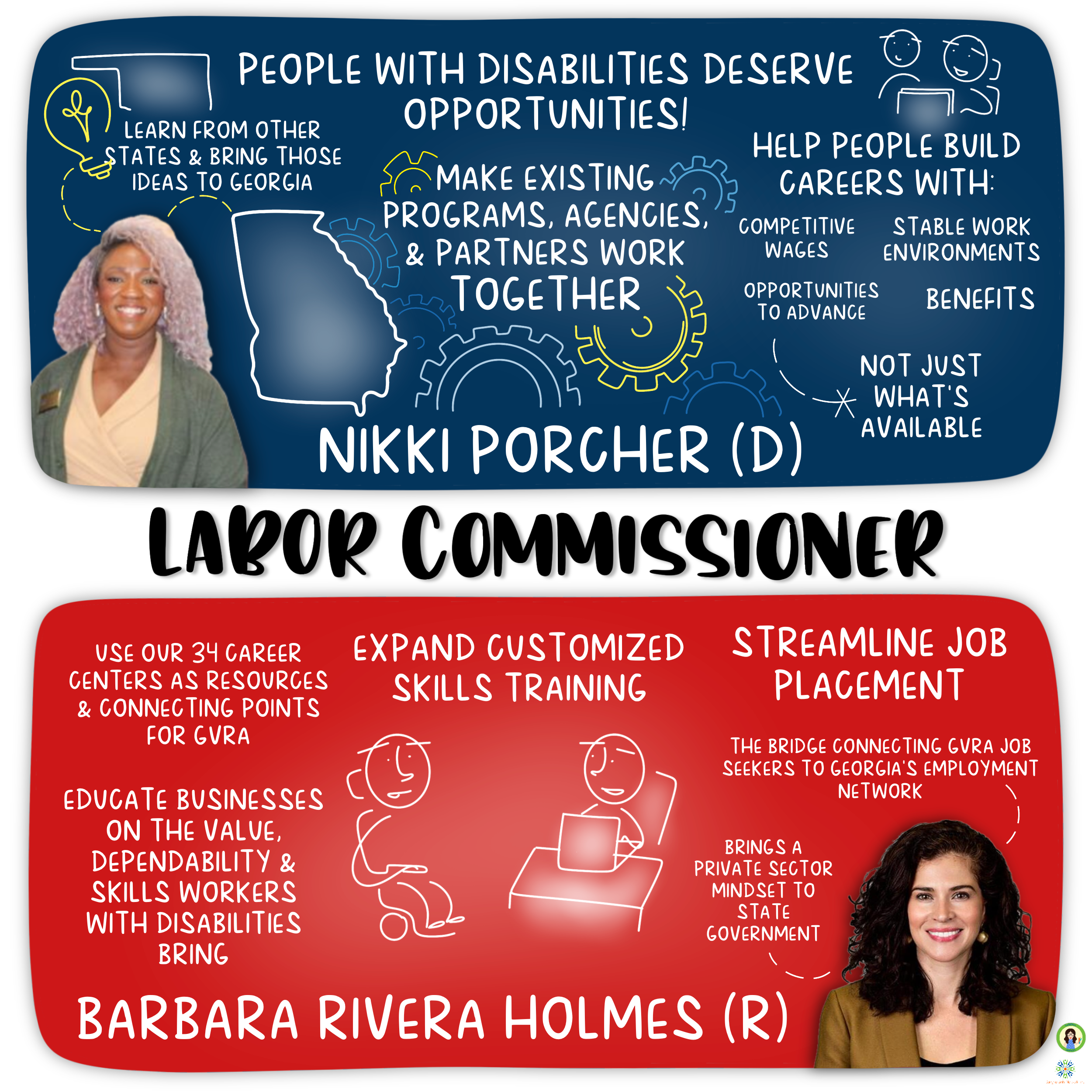
Candidates Nikki Porcher and current Commissioner Bárbara Rivera Holmes were asked how the Georgia Department of Labor could work with the Georgia Vocational Rehabilitation Agency (GVRA) and other partners to make it easier for people with disabilities to build careers.

Porcher, a U.S. Air Force veteran with post-traumatic stress disorder (PTSD), emphasized that not every disability is visible. She proposed a “no wrong door” approach in which people with disabilities would receive coordinated support or a “warm handoff” no matter where they first ask for help. “Programs need to be working together,” said Porcher, “whether someone is going through the Georgia’s Department of Labor, Vocational Rehabilitation Agency, WorkSource Georgia, technical colleges, veteran organizations, or community partners.”

Holmes discussed her work as Georgia’s current Labor Commissioner in a pre-recorded response. She connects job seekers from GVRA with Georgia employers through the state’s 34 career centers. She emphasized the importance of helping businesses understand the skills and value that workers with disabilities bring to the workplace. Holmes said this education can help remove stigma and open doors.

Superintendent of Schools

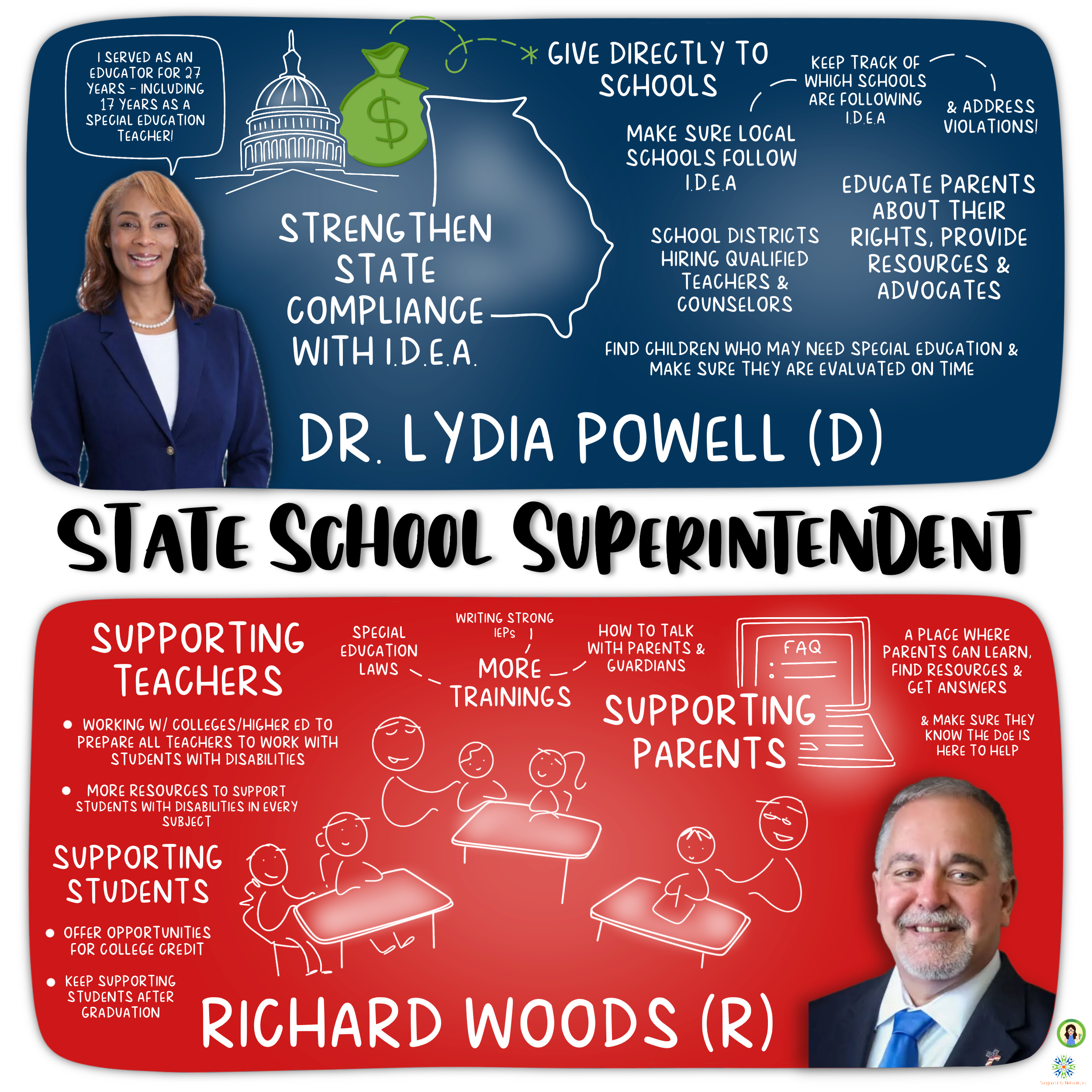
Candidates Dr. Lydia Powell and current Superintendent Richard Woods talked about how Georgia can meet the requirements of the federal Individuals with Disabilities Education Act (IDEA). This law gives students with disabilities the right to a free and appropriate public education. It also says they should learn in the least restrictive environment. This means they should learn alongside students without disabilities as much as possible.

Powell said she would strengthen state oversight and provide funding where it is needed most. Targeted funding would go towards hiring qualified teachers and school psychologists. It would also help to improve the Child Find process. This program helps schools identify and support children who have disabilities.

Woods said improving disability education begins with teachers and training. He supports building stronger partnerships with colleges and universities to better prepare educators to teach students with disabilities.

Both candidates emphasized the importance of educating parents and connecting them with resources.

Attorney General

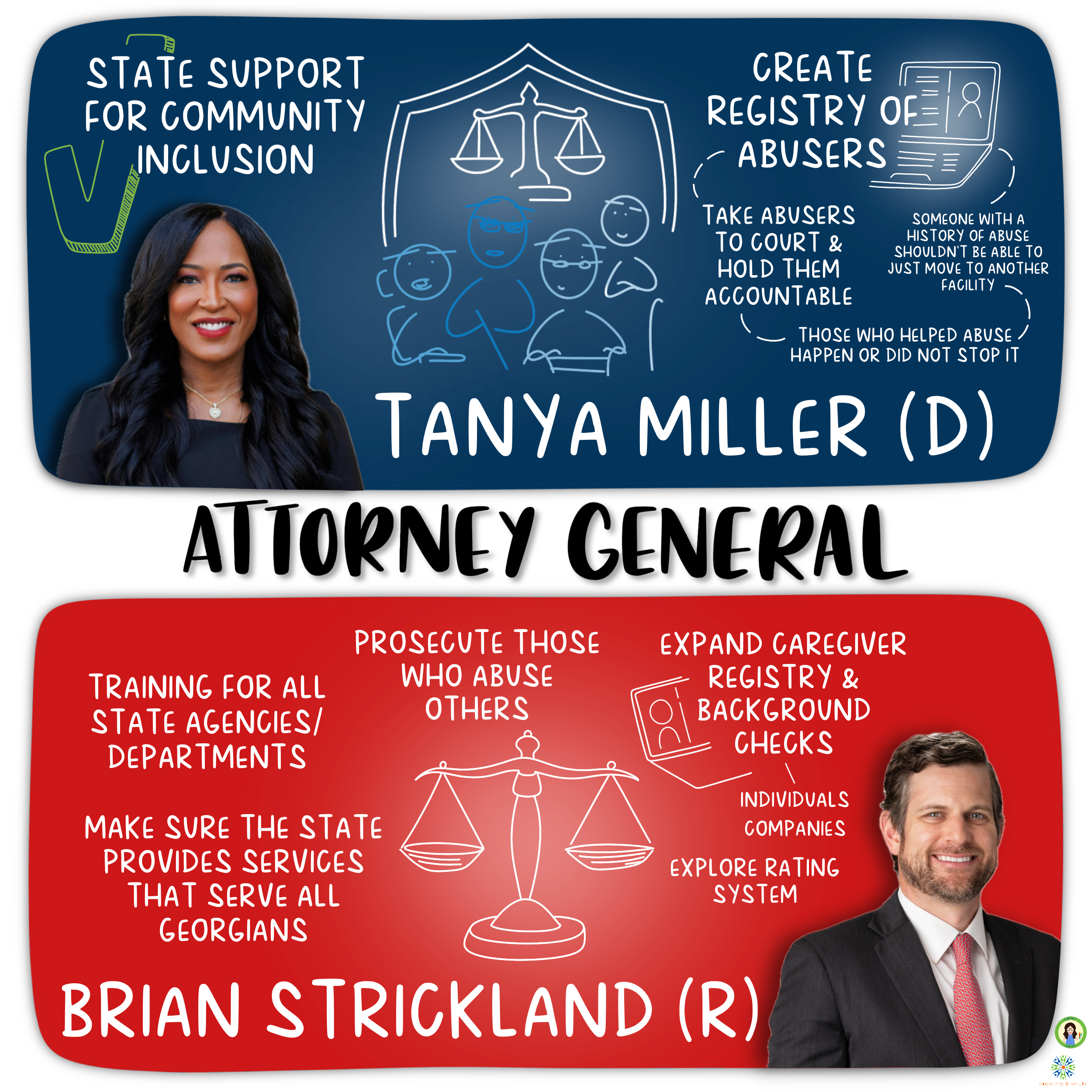
Candidates Sen. Brian Strickland and Rep. Tanya Miller were asked how they plan to protect Georgians with disabilities from abuse and neglect.

Strickland highlighted that state agencies need to have proper training for working with people with disabilities. He wants to consider ways to expand Georgia’s caregiver registry to help the state identify caregivers with a history of abuse or neglect.

Miller focused on enforcing the law and holding people accountable. She drew on her experience as a homicide prosecutor who has stood with victims of abuse. Miller said an abuse registry is necessary, along with a clear process for acting on the information it provides.

Governor

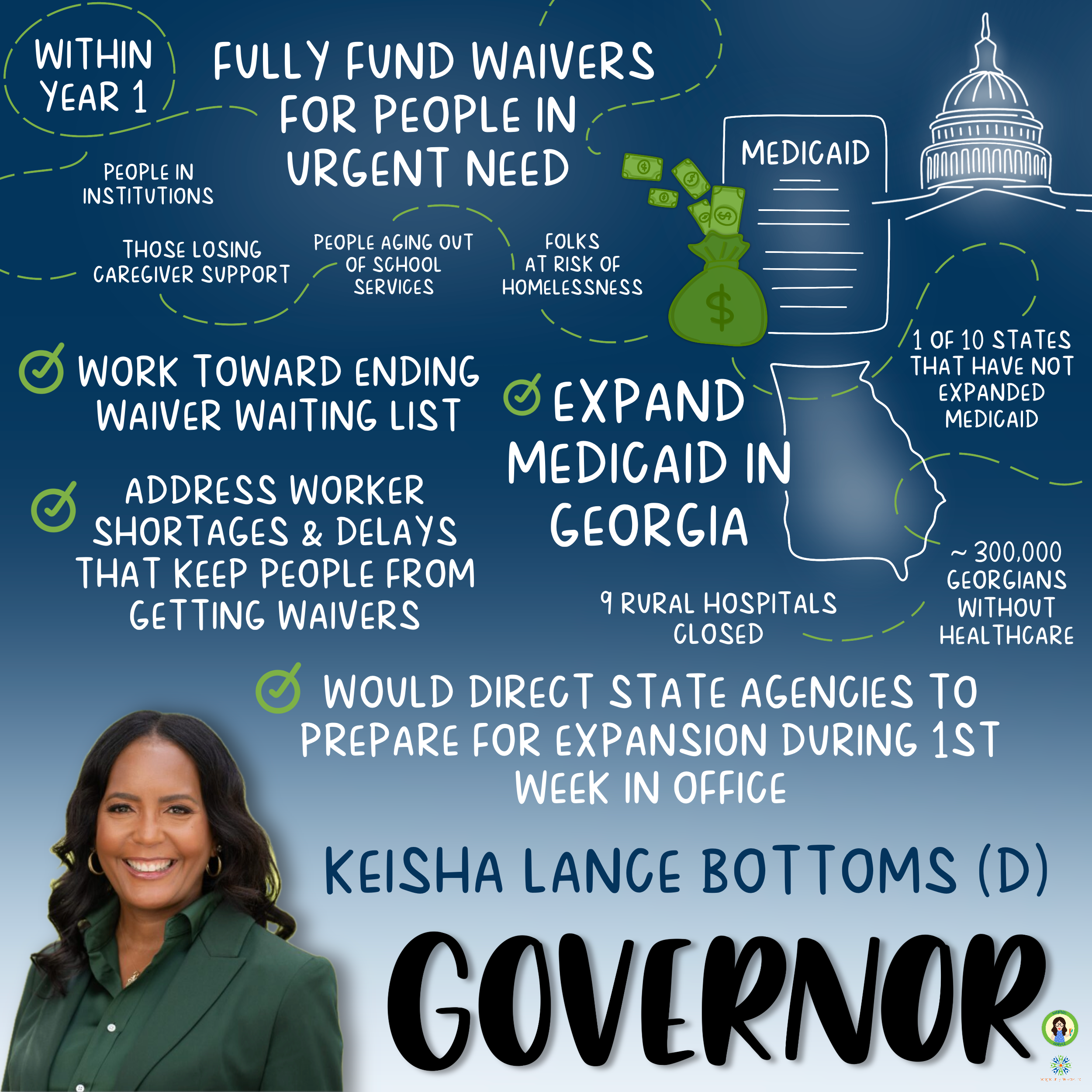
Gubernatorial candidate Keisha Lance Bottoms said in a prerecorded statement that 1,217 individuals were identified as being in urgent need of a NOW/COMP waiver. These waivers provide home and community-based services that allow people with developmental disabilities (DD) to live in their communities. Bottoms said a top priority during her first year in office would be to fully fund waivers for people in urgent need. She said expanding Medicaid would be a major priority of her administration.

Rick Jackson did not participate in the forum in person or submit a video response.

Lieutenant Governor

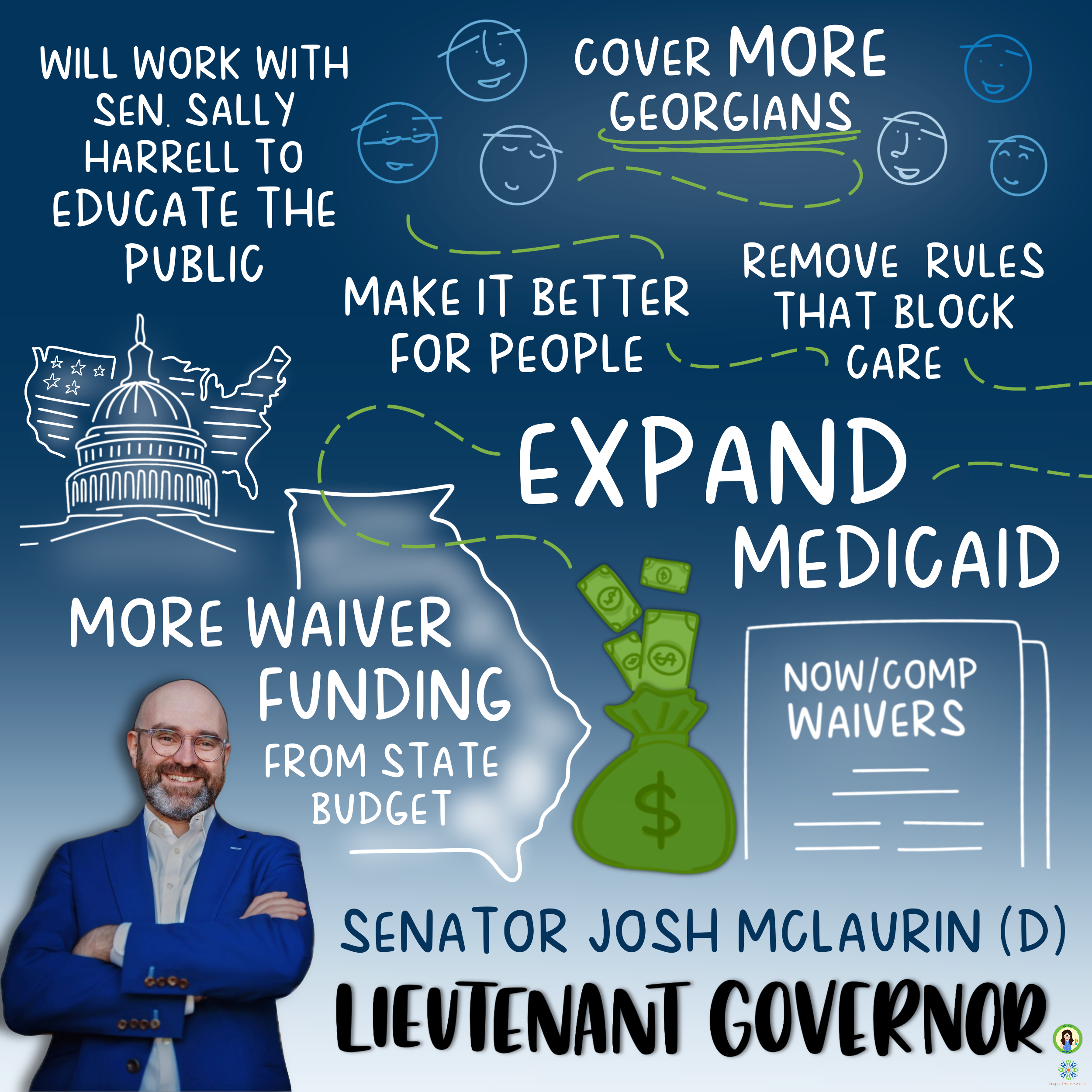
Candidate Sen. Josh McLaurin said he strongly supports expanding funding for the NOW and COMP waivers. He also expressed support for Medicaid expansion.

Candidates for Secretary of State Penny Brown Reynolds and Tim Flemming; and US Senators Jon Ossoff and Mike Collins were also invited to participate. Unfortunately they were unable to do so.

Stacy Ramirez, a member of the Rev Up Georgia Coalition, ended the discussion with information about voter accessibility. To be vote-ready, she said to check voter registration on Georgia’s My Voter Page, know important dates, have a plan for when and how to vote, and save the non-partisan voter helpline phone number 1-866-OUR-VOTE (1-866-687-8683). Read more in the Public Policy for the People article.

Watch the entire Forum on GCDD’s YouTube channel, and download the PDF from Rev Up Georgia.

Public Policy For The People

What's Happening in Your Town

What’s Happening in Your Town?

What’s going well in your community?

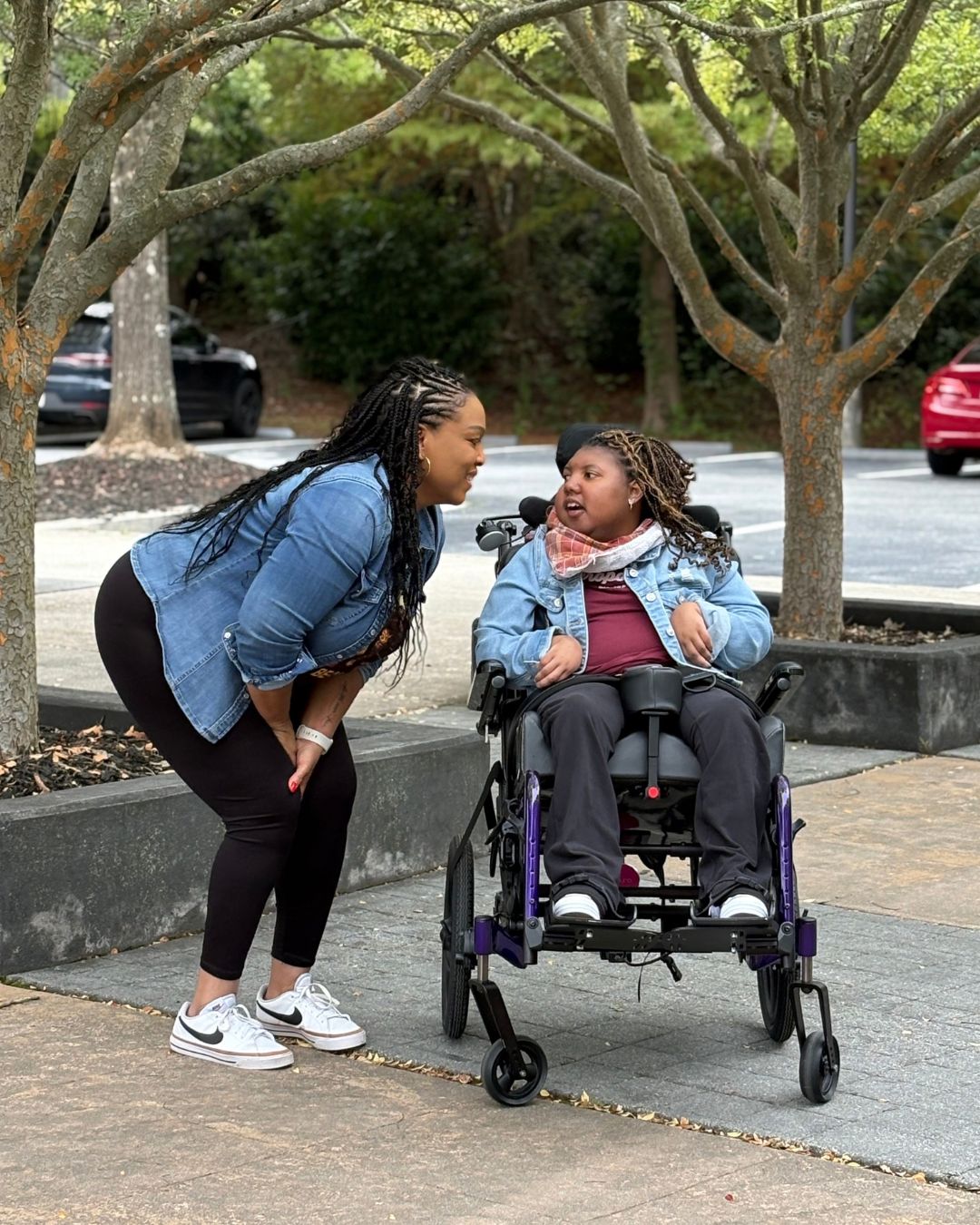
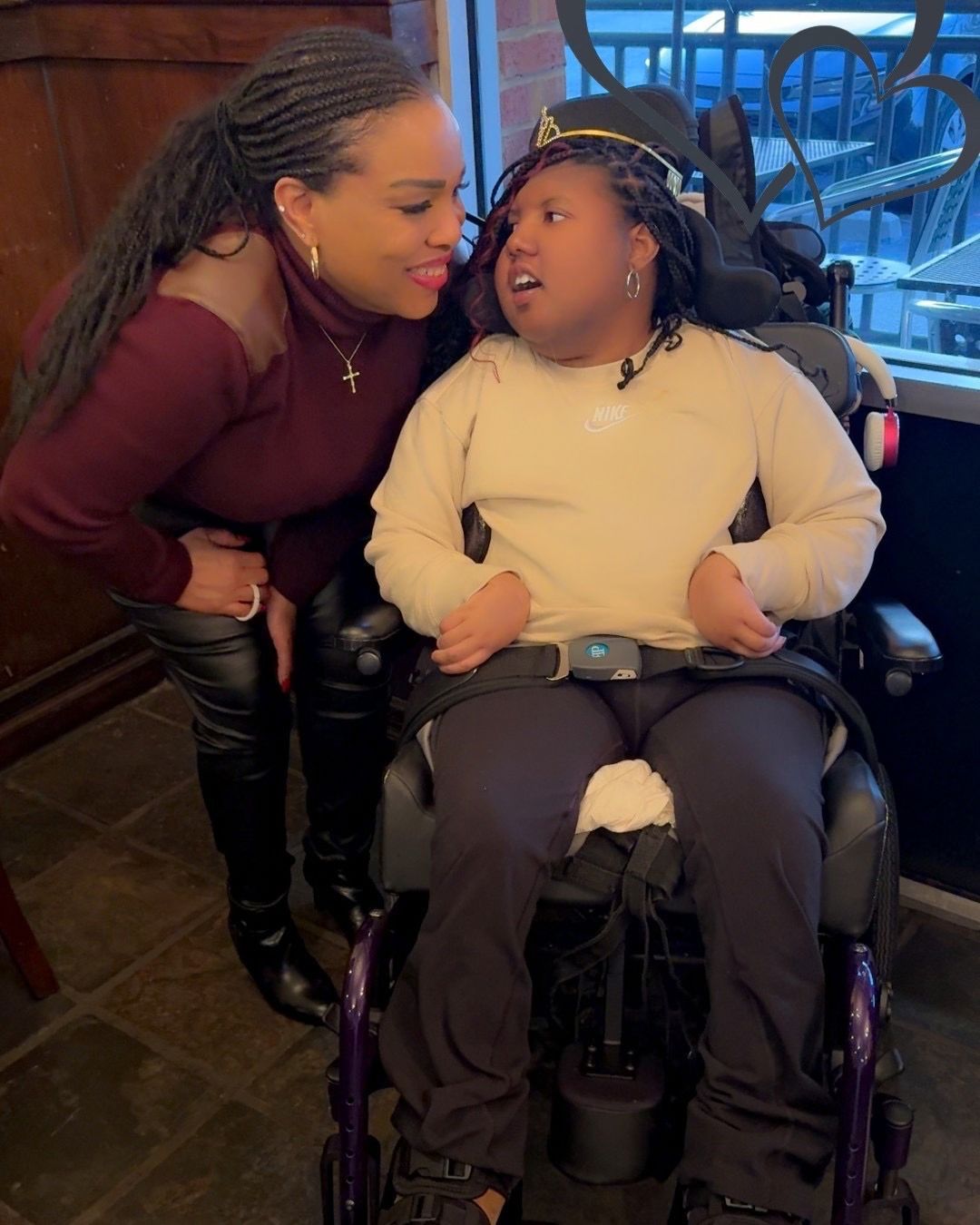
Accessibility is more than a ramp. Batoya and Aysia

When I take my daughter Aysia into our community, I do not just think about whether a place has an accessible entrance. I think about the entire experience.

Aysia is 24, uses a wheelchair, needs significant assistance with her daily care, and communicates without words. She has a voice. We have simply learned how to listen to her.

I am encouraged by the accessibility improvements happening in Gwinnett County. Discovery Park in Lawrenceville is being developed with an inclusive playground, accessible pathways, trails, parking, and restroom facilities. I truly celebrate that progress.

But my experience has taught me that accessibility is more than a ramp, a parking space, or an accessible playground.

For Aysia, I have to ask: Can she use the restroom? Can her caregiver safely assist her? Is there enough space for her wheelchair? Can she receive the personal care she needs with dignity?

A restroom can meet ADA requirements and still not meet the needs of every person with a disability.

I am not sharing this to criticize. I want us to continue building on the progress we are making.

Batoya and AysiaWhen we design parks and public spaces, I hope we will ask people with disabilities and their families what they need before the plans are finished.

Because inclusion is not just about whether someone can get in.

It is about whether they can participate, stay, receive the support they need, and truly feel like they belong.

That is the community I want for Aysia and for all of her friends.

Living in Gwinnett has given Aysia and our family more opportunities to get out, enjoy our community, and experience things together. I’m encouraged by the growth of accessible parks, recreation programs, trails, and inclusive spaces. Seeing projects like Discovery Park include accessibility features gives me hope for an even more welcoming community.

For me, true inclusion means more than being able to enter a place. It means being able to participate, enjoy the experience, and feel like you belong. I’m excited about the progress we’re making and hopeful that we will continue listening to people with disabilities and their families as we build an even more inclusive Gwinnett.

Self-Advocate Spotlight, What's Happening in Your Town?

GCDD Impact

Join a Listening Session: Help Inform the Future of NOW & COMP Waivers

Georgia State University (GSU), in partnership with the Georgia Council on Developmental Disabilities, is conducting an in-depth analysis of the return on investment (ROI) of the NOW/COMP Medicaid waivers.

As part of this research study, GSU is hosting listening sessions to gather insights from:

  • People and families who currently receive waivers
  • People and families who are on the waitlist for a waiver
  • Home and community-based services (HBCS) providers including agency representatives and direct support professionals
  • State staff who oversee program services, write policy, and manage data.

These conversations will help identify the real-world impacts, costs, and benefits of the waivers. They will also ensure that findings reflect the experiences of those closest to the programs. What you share at the listening sessions will help GSU choose what information to study and how to share what we learn with leaders.

Those selected for a listening session will be invited to participate in a one-time virtual group discussion with others who share similar experiences. Chosen participants can receive a $50 gift card.

Listening session dates are:

Waiver Participants: Wednesday, October 13, 2026, 5:00 PM
Waitlist (Planning List) Participants: Wednesday, October 21, 2026, 5:00 PM
HCBS Providers: [TBD]
State Staff / Administrators: [TBD]

Interested in participating? Complete the interest form at https://forms.cloud.microsoft/r/BUr8qXu7MG.

Have questions? Contact us at or 404-413-3683.

GCDD Impact

Calendar of Events

Upcoming Events in Georgia – October 2026

Monday, October 5 — Last Day to Register to Vote

This is the last day to register to vote or update your address for the November 3 General Election. Georgia does not have same-day voter registration.
Register or check your status at the Georgia My Voter Page: mvp.sos.ga.gov

Tuesday, October 6 — Our Voice, Our Vote 2026

10 a.m., online (Zoom)
Hosted by Uniting for Change
Learn more: uniting4change.org/calendar

Tuesday, October 6 — Webinar: GROWing Recovery in the Workplace: Georgia’s Statewide Initiative

1–2 p.m., online (Zoom)
Speaker: Reginald “Reggie” McGruder, Georgia Council for Recovery
Hosted by Advancing Employment
Learn about the Georgia Recovery-Ready Workplace (GROW) initiative. It connects large employers with local recovery community organizations to build workplaces that support people in recovery from substance use disorders.
Register: zoom.us/meeting/register/nAFMb0-0Soevkrx9W_mZIQ

Tuesday, October 13 — Webinar: Let Me Do It: Tech-Enabled Supported Decision-Making

1–2 p.m., online (Zoom)
Speakers: Angad Sahgal and Amit Sahgal
Hosted by Advancing Employment
Meet the Atlanta-based father and son team behind Let Me Do It, a platform that helps people with disabilities make their own decisions through Supported Decision-Making.
Register: zoom.us/meeting/register/siwRxSRbQoS6b7IaBWrZIQ

Tuesday, October 13 — Early Voting Begins

Early voting runs October 13 through October 30. Any registered voter can vote early. Find early voting locations and hours on the My Voter Page.

Saturday, October 17 — Saturday Early Voting

Georgia requires Saturday early voting on October 17 and October 24. Some counties may also offer Sunday voting.

Tuesday, October 20 — Webinar: Celebrating Value and Talent: A Discussion on Inclusion, Progress, and Growth in Georgia

1–2 p.m., online (Zoom)
Speakers: Ginia Taylor and Zac Bradley
Hosted by Advancing Employment
Two Georgia leaders discuss where the state is meeting the standards of inclusion and where there is still room to grow. The discussion includes time for questions.
Register: zoom.us/meeting/register/AhHd-DumR1ifMEAWU4DJgw

Thursday, October 22, and Friday, October 23 — GCDD Quarterly Council Meeting

Hotel Indigo Savannah Historic District, 201 W. Bay Street, Savannah
Thursday: 10 a.m.–4:30 p.m.
Friday: 9 a.m.–1 p.m.
Hosted by the Georgia Council on Developmental Disabilities
Council members meet each quarter to learn what is happening for people with developmental disabilities and their families in Georgia and across the nation. The public is welcome.

  • Public comment: Thursday at 4:15 p.m. Each person may speak for up to 5 minutes. You can also email written comments to .

  • Friday luncheon: A community luncheon with a presentation and a question-and-answer session begins at 11:30 a.m.

  • To attend or give public comment: RSVP at gcdd.org/about/gcdd-meetings. After you register, you will get a confirmation email.

Friday, October 23 — Last Day to Apply for an Absentee Ballot

Your county election office must receive your absentee ballot application by this date.

Saturday, October 24 — Saturday Early Voting

This is the second required Saturday of early voting.

Tuesday, October 27 — Celebrating Value and Talent (in person)

9 a.m.–1 p.m.
Tubman Museum, 310 Cherry Street, Macon
Hosted by Advancing Employment
This free community celebration honors the contributions of people with disabilities in the workforce. Food trucks will be on site.
Register: advancingemployment.com/ndeam-2026

Friday, October 30 — Last Day of Early Voting

Early voting ends on the Friday before Election Day.

Coming up: Tuesday, November 3 — Election Day

Polls are open from 7 a.m. to 7 p.m. On Election Day, you must vote at your assigned polling place. Find it on the My Voter Page.

Calendar of Events